接着 销售流程 AI 化系列 的汽配分销商案例讲。
上一篇讲的是理念:解决方案对象、拜访质检、履约 SOP 编译。这一篇讲落地:FDE 到客户现场,怎么用基础设施在一天内把这些理念变成可运行的 Agent。
老周(售前)和小林(FDE)一起到了汽配客户现场。客户有 200 家门店,销售团队 30 人,每天处理 50+ 客户咨询、20+ 报价单、10+ 合同审批。
问题是:销售流程全靠人肉,信息散落在微信、Excel、邮件里,老周那份 80 页 PPT 签完单就死了。
09:00 — 业务调研(用 SOP 采集器)
小林不是拿着笔记本记,而是打开钉钉小程序「SOP 采集器」,跟着销售总监走了一遍完整流程:
客户咨询
    ↓
需求确认(30 分钟)
    ↓
报价(2 小时,等财务确认成本)
    ↓
方案讲解(1 小时)
    ↓
合同审批(3 天,等法务 + 总经理)
    ↓
签约(1 天)
    ↓
交付(5 天)
    ↓
售后(持续)
小林问:「哪个环节最耗时?」
销售总监:「报价和合同审批。报价要等财务算成本,合同要等法务审条款,加起来 5 天。但真正干活的时间不到 4 小时,剩下全是等待。」
小林在采集器里标注:
{
  "step": "报价",
  "duration_hours": 48,
  "active_hours": 2,
  "wait_hours": 46,
  "bottleneck": "财务确认成本",
  "ai_opportunity": "历史报价 + 成本模型 → 自动报价",
  "roi": "30 销售 × 20 报价/月 × 46 小时/报价 = 27,600 小时/月"
}
# generated by hugo AI
ROI 计算器自动算出:如果报价环节从 48 小时降到 4 小时,每月节省 27,600 小时等待时间,折合 115 个工作日。
这就是 业务抽象能力 里说的:不是听到「报价慢」就做一个报价工具,而是算出「等待时间 × 人数 × 频次」的真实成本。
11:00 — 工作流抽象(用工作流画布)
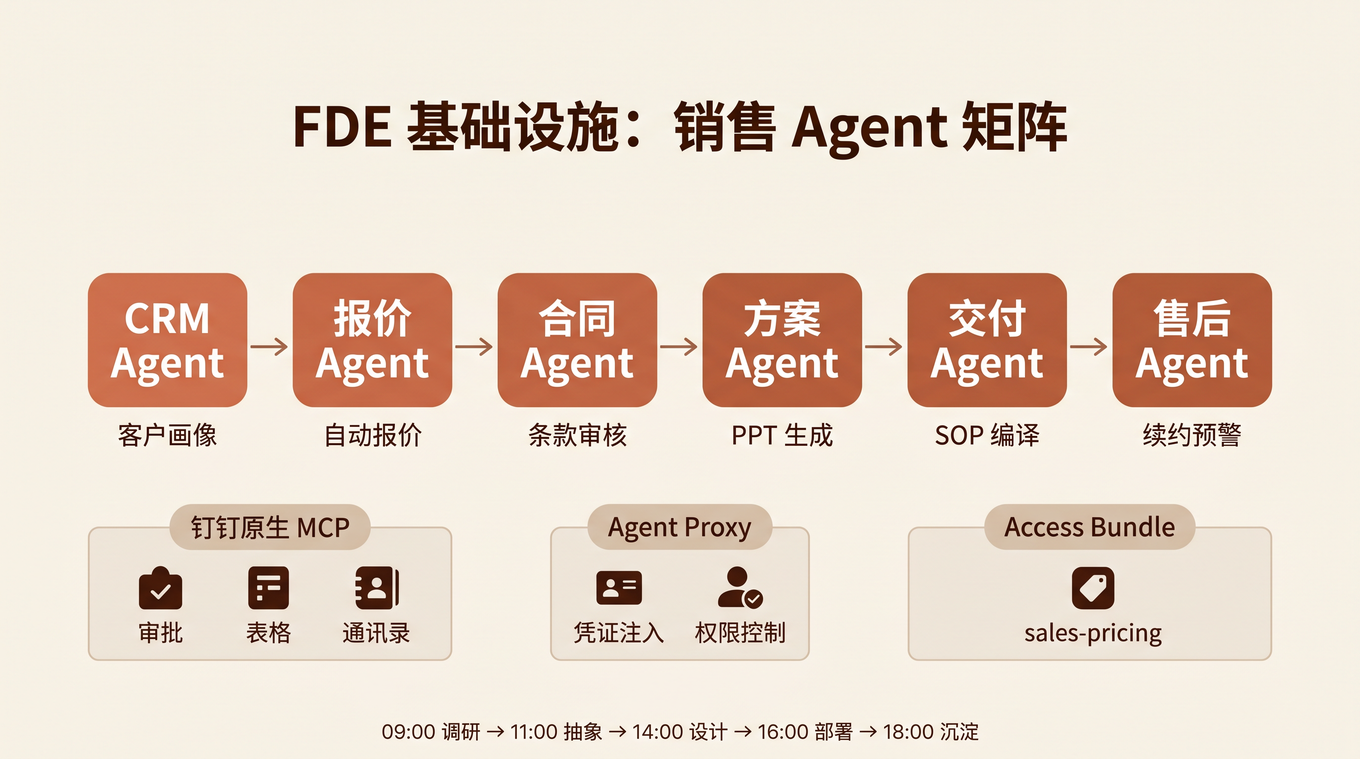
小林打开 Web 画布,把销售流程拆成 Agent 矩阵:
销售流程 Agent 矩阵
┌─────────────────────────────────────────────────────────────┐
│  CRM Agent        客户画像 + 历史记录 + 跟进提醒             │
│  报价 Agent       历史报价 + 成本模型 + 自动报价 + 审批       │
│  合同 Agent       条款模板 + 法务审核 + 电子签章             │
│  方案 Agent       解决方案对象 + 竞品对比 + PPT 生成         │
│  交付 Agent       履约 SOP 编译 + 进度追踪 + 异常预警        │
│  售后 Agent       客户反馈 + 续约预警 + 增购推荐             │
└─────────────────────────────────────────────────────────────┘
不是一个超级 Agent。
而是六个专业 Agent 协作。
小林在画布上标注每个 Agent 的输入输出:
CRM Agent
  输入:客户咨询(钉钉群消息)
  输出:客户画像卡片(AI 表格)

报价 Agent
  输入:客户需求(CRM Agent 输出)
  输出:报价单(PDF)+ 审批请求(钉钉审批流)

合同 Agent
  输入:报价单 + 客户资质
  输出:合同草案(钉钉文档)+ 法务审核请求
这就是 工作流思维:把岗位工作拆成多个专业 Agent,每个 Agent 只做一件事,协作完成端到端流程。
14:00 — Agent 设计(用 Agent 脚手架)
下午,小林打开终端,用脚手架快速创建第一个 Agent:
dws agent create quote-agent \
  --template pricing-automation \
  --scope channel:销售报价群 \
  --bundle sales-pricing
脚手架自动生成项目结构:
quote-agent/
├── agent.yaml          # Agent 配置
├── tools/
│   ├── pricing_model.py    # 报价模型
│   └── approval_flow.py    # 审批流
├── mcp/
│   └── dingtalk_table.py   # AI 表格 MCP Server
└── README.md
小林编辑 agent.yaml:
name: 报价 Agent
agent_id: agent://sales-pricing
memory_scope: workspace
triggers:
  - event: message_received
    pattern: "报价|询价|价格"
tools:
  - name: query_historical_quotes
    mcp_server: dingtalk-table
    params:
      table: 历史报价
      fields: [客户, 产品, 单价, 日期]
  - name: calculate_cost
    mcp_server: erp-cost
    params:
      product_id: required
      quantity: required
  - name: create_approval
    mcp_server: dingtalk-approval
    params:
      template: 报价审批
outputs:
  - type: dingtalk_message
    template: 报价单卡片
  - type: dingtalk_approval
    condition: amount > 100000
# generated by hugo AI
然后接入 MCP Server:
dws mcp connect dingtalk-table --token xxx
dws mcp connect erp-cost --token yyy
dws mcp connect dingtalk-approval --token zzz
30 秒接好三个系统。
小林用 AI Coding 写了一个简单的报价模型:
from dataclasses import dataclass
from typing import Optional

@dataclass
class QuoteAgent:
    """报价 Agent:历史报价 + 成本模型 → 自动报价"""

    agent_id: str = "agent://sales-pricing"
    memory_scope: str = "workspace"

    def query_historical_quotes(self, customer: str, product: str) -> list:
        """查询历史报价"""
        return self.mcp_call("dingtalk-table", "query", {
            "table": "历史报价",
            "filter": f"客户='{customer}' AND 产品='{product}'",
            "order_by": "日期 DESC",
            "limit": 5,
        })

    def calculate_cost(self, product_id: str, quantity: int) -> float:
        """调用 ERP 计算成本"""
        return self.mcp_call("erp-cost", "calculate", {
            "product_id": product_id,
            "quantity": quantity,
        })

    def generate_quote(self, customer: str, product: str, quantity: int) -> dict:
        """生成报价单"""
        history = self.query_historical_quotes(customer, product)
        cost = self.calculate_cost(product, quantity)

        # 简单模型:历史均价 × 1.2(20% 毛利)
        if history:
            avg_price = sum(h["单价"] for h in history) / len(history)
            unit_price = max(avg_price, cost * 1.2)
        else:
            unit_price = cost * 1.3  # 新客户 30% 毛利

        total = unit_price * quantity
        return {
            "customer": customer,
            "product": product,
            "quantity": quantity,
            "unit_price": unit_price,
            "total": total,
            "approval_required": total > 100000,
        }

    def create_approval(self, quote: dict) -> str:
        """发起审批流"""
        if quote["approval_required"]:
            return self.mcp_call("dingtalk-approval", "create", {
                "template": "报价审批",
                "data": quote,
                "approvers": ["财务经理", "销售总监"],
            })
        return "auto_approved"
# generated by hugo AI
16:00 — 部署上线(用 Agent Proxy + Access Bundle)
小林部署 Agent 到销售报价群:
dws agent deploy quote-agent --scope channel:销售报价群
背后发生了什么?
1. Agent Registry 注册身份
{
  "agent_id": "agent://sales-pricing",
  "display_name": "报价 Agent",
  "department": "销售部",
  "bundle": "sales-pricing",
  "memory_scope": "workspace"
}
Agent 有自己的身份,不是借用销售总监的 Token。
2. Access Bundle 绑定权限
name: sales-pricing
connections:
  - name: dingtalk-table
    host: table.dingtalk.com
    credential_ref: table_token_sales
    mode: read
    path_prefix: /api/v2/tables/历史报价

  - name: erp-cost
    host: erp.customer.com
    credential_ref: erp_api_key
    mode: read
    path_prefix: /api/cost

  - name: dingtalk-approval
    host: approval.dingtalk.com
    credential_ref: approval_token
    mode: write
    path_prefix: /api/v2/approvals

allowed_domains:
  - dingtalk.com
  - customer.com
Agent 只能访问「历史报价表」,不能访问「客户黑名单表」;只能读 ERP 成本,不能改价格。
3. Agent Proxy 边界注入
Agent 在沙箱里运行,沙箱不持有任何凭证。
Agent 调用 MCP Server 时:
Agent: requests.get("https://erp.customer.com/api/cost?product_id=123")
    ↓ (沙箱内 DNS 劫持)
Agent Proxy: 检查 Connection Rules
    ↓ (命中 erp-cost, mode=read)
Agent Proxy: 注入 erp_api_key → 转发请求
    ↓
ERP: 返回成本数据(Agent 看不到 API Key)
即使 Agent 被 prompt injection 攻击,也泄露不了 API Key——因为凭证根本不在沙箱里。
这就是 Agent IAM 架构 的三层设计:Session Sandbox + Agent Proxy + Access Bundle。
4. 双轨审计
每次 Agent 操作,日志同时记录人和 Agent:
{
  "timestamp": "2026-06-29T14:30:00+08:00",
  "human_requester": "张三 (销售)",
  "agent_executor": "agent://sales-pricing",
  "session_id": "ses_thread_xyz",
  "action": "generate_quote",
  "data_source": "dingtalk-table://历史报价",
  "access_bundle": "sales-pricing",
  "result": {
    "customer": "汽配连锁 A",
    "total": 150000,
    "approval_required": true
  },
  "proxy_log": [
    {"host": "table.dingtalk.com", "status": "forwarded", "credential": "table_token_sales"},
    {"host": "erp.customer.com", "status": "forwarded", "credential": "erp_api_key"},
    {"host": "approval.dingtalk.com", "status": "forwarded", "credential": "approval_token"}
  ]
}
出了事能追溯:是张三发起的,报价 Agent 执行的,用了销售报价 Bundle 的权限。
18:00 — 产品沉淀(用模式库)
晚上,小林回到酒店,写了一份模式识别报告:
本周客户调研(5 家销售型公司)

共同模式:
  - 报价环节耗时最长(5/5)
  - 历史报价散落在 Excel(5/5)
  - 审批流程断裂:销售不知道审批到哪了(4/5)
  - 缺少「报价 → 合同 → 交付」的链路追踪(5/5)

已验证 Agent:
  - 报价 Agent(汽配客户 A,上线 1 天,处理 12 个报价,平均 15 分钟/个)
  - ROI:从 48 小时 → 4 小时,节省 44 小时/报价

建议:
  - 进入「钉钉销售 Agent」产品规划
  - 优先做「报价 Agent + 合同 Agent」
  - 复用 [解决方案对象](https://hugozhu.site/post/2026/251-ai-native-sales-presales-solution-object/) 模式
  - 参考 [拜访质检](https://hugozhu.site/post/2026/252-ai-native-sales-pitch-qa-coaching/) 的方案校验逻辑
如果十家公司都在做「报价自动化」,那就应该进入「钉钉销售 Agent」产品规划,而不是继续实施。
基础设施全景
以销售流程为例,FDE 用到的基础设施:
| 时间 | 阶段 | 基础设施 | 作用 |
|---|---|---|---|
| 09:00 | 业务调研 | SOP 采集器 + ROI 计算器 | 量化等待时间成本 |
| 11:00 | 工作流抽象 | Web 画布 | 拆出 6 个专业 Agent |
| 14:00 | Agent 设计 | Agent 脚手架 + MCP Server | 30 秒接好钉钉表格、ERP、审批 |
| 16:00 | 部署上线 | Agent Registry + Proxy + Bundle | 安全隔离 + 权限控制 + 双轨审计 |
| 18:00 | 产品沉淀 | 模式库 | 识别「10 家客户都做了报价 Agent」 |
一句话总结:基础设施让 FDE 从「做项目」变成「做产品」——一天验证一个业务想法,一周沉淀一个标准 Agent。
你的企业销售流程里,哪个环节最耗时?是报价、合同、还是交付?有没有想过用 Agent 矩阵来拆解?欢迎留言讨论。